Tantric Practices for Enhancing Your Love Life

You’ve probably heard the word tantra tossed around in spas, retreats, or late-night YouTube scrolls-but what if it’s not about wild sex or mystical rituals? What if it’s actually about slowing down, paying attention, and reconnecting with your partner in a way that feels deeper than anything you’ve tried before?
Most couples get stuck in the same rhythm: work, dinner, scrolling, sleep. The spark fades not because love is gone, but because presence is missing. Tantra doesn’t promise fireworks. It offers something quieter, more powerful: a way to rebuild intimacy one breath, one touch, one moment at a time.
What Tantra Really Is (And What It Isn’t)
Tantra isn’t a set of positions or a guide to lasting longer in bed. It’s an ancient spiritual system from India that sees sexuality as a sacred energy-not something to be used, but something to be honored. At its core, tantra teaches that pleasure isn’t just physical. It’s a doorway to connection, awareness, and even transcendence.
Modern pop culture has turned tantra into a buzzword for exotic massages or erotic workshops. But real tantric practice? It’s about presence. It’s about feeling the warmth of your partner’s hand without thinking about what’s next. It’s about holding eye contact until the awkwardness melts into something tender.
Think of it like this: most relationships run on autopilot. Tantra is the reset button. It doesn’t fix problems. It helps you stop running from them-and start feeling them together.
Why Tantric Practices Work for Love
Science backs this up. A 2021 study from the University of California found that couples who practiced mindful touch for just 10 minutes a day reported a 37% increase in emotional closeness over eight weeks. Why? Because touch without agenda activates the vagus nerve-the part of your nervous system that calms stress and boosts bonding hormones like oxytocin.
Tantric practices work because they interrupt the cycle of performance anxiety. You’re not trying to get off. You’re not trying to please. You’re just being. And when you stop chasing outcomes, something unexpected happens: desire returns-not as pressure, but as curiosity.
One couple I know, Sarah and Mark, stopped having sex for nine months after their baby was born. They felt like roommates. Then they tried a simple tantric exercise: sitting face-to-face, breathing together for five minutes, no talking, no touching beyond holding hands. After three days, Mark said, “I forgot how much I loved the way she smells.” That’s the magic. It’s not about sex. It’s about remembering why you wanted to be close in the first place.
Simple Tantric Practices You Can Start Today
You don’t need candles, incense, or a retreat in Bali. You just need ten minutes and a willingness to be still.
- Eye Gazing - Sit across from each other, knees touching if you can. Look into each other’s eyes. No smiling. No talking. Just look. Start with two minutes. Work up to ten. It sounds silly. It feels vulnerable. And it’s one of the fastest ways to dissolve emotional distance.
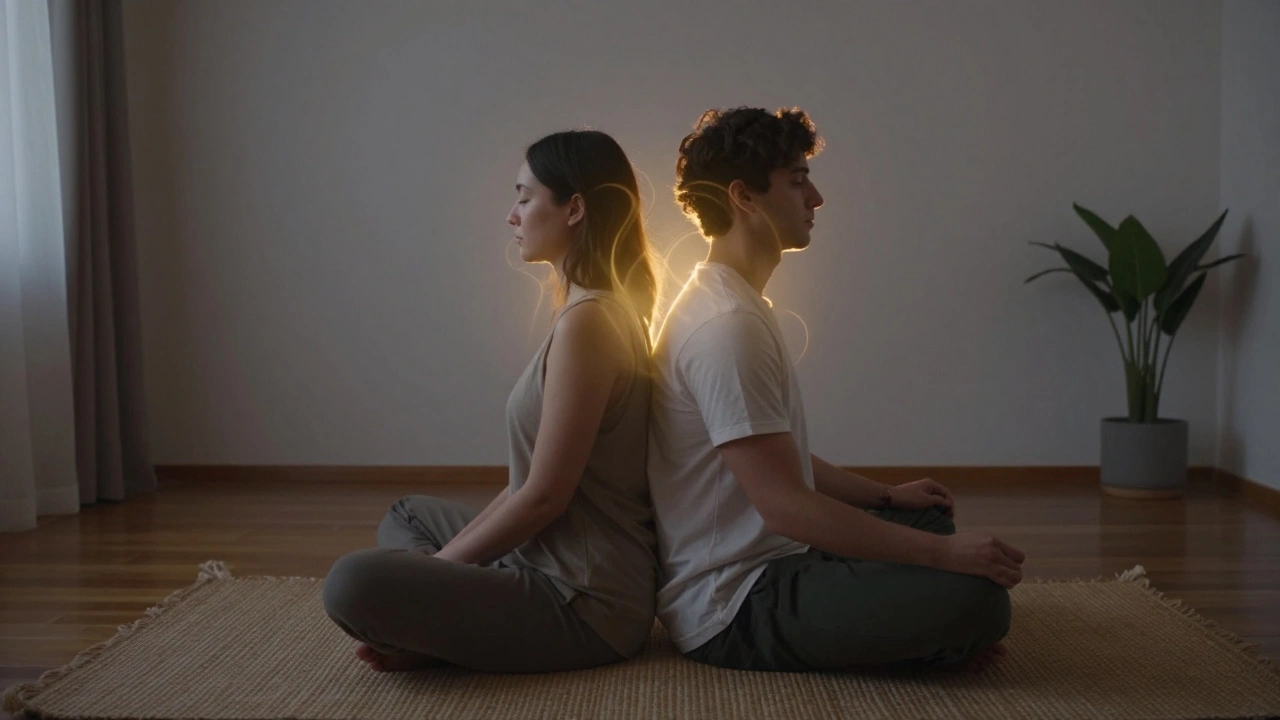
- Breath Synchronization - Sit back to back or side by side. Match your inhales and exhales. Breathe in for four counts, hold for two, breathe out for six. Do this for five minutes. Your heart rates will sync. Your nervous systems will calm. You’ll feel like you’re in the same body.
- Non-Sexual Touch Ritual - Take turns giving a five-minute massage-no genitals, no breasts, no pressure to perform. Just hands on shoulders, arms, feet. Use warm oil if you have it. Focus on sensation, not technique. Notice how your partner tenses, how they relax. This rebuilds trust in touch.
- The Pause Before Sex - Before anything else, lie down together. Close your eyes. Breathe together for three full minutes. Whisper one thing you appreciate about your partner. Then, and only then, begin. This turns sex from a goal into a shared experience.
These aren’t tricks. They’re habits. And habits change relationships faster than any grand gesture.
Common Misconceptions About Tantra
Let’s clear up a few myths right now.
- Myth: Tantra is about having multiple orgasms. Truth: It’s about extending presence-not pleasure. Many tantric practices don’t involve orgasm at all.
- Myth: You need a teacher or guru. Truth: You can start alone, with your partner, and without any tools. The only requirement is attention.
- Myth: Tantra is only for couples. Truth: Solo tantric practices-like breathwork, meditation, and self-touch with awareness-are powerful for healing personal blocks that affect intimacy.
- Myth: It’s spiritual so it’s not sexual. Truth: Tantra says sexuality is sacred. Not dirty. Not shameful. Not separate from spirit.
The biggest mistake people make? Treating tantra like a technique to “fix” their sex life. It’s not a fix. It’s a return.
How Tantra Differs From Regular Sex Therapy
Sex therapy often focuses on problems: low desire, premature ejaculation, mismatched libidos. It’s clinical. It’s solution-oriented.
Tantra doesn’t fix problems. It changes the ground they grow on. Instead of asking, “Why don’t we have sex more?” it asks, “What are we avoiding when we avoid each other?”
One woman told me she went to a sex therapist after three years of no intimacy. They worked on communication, schedules, hormones. Nothing changed. Then she tried a 10-minute breath practice with her husband. “We didn’t have sex that night,” she said. “But we cried together. And the next day, he held my hand while we watched TV. That was the first time in years.”
Tantra doesn’t ignore the body. It listens to it. And sometimes, the body speaks louder when you stop trying to control it.
What to Expect During a Tantric Session (If You Try One)
If you decide to explore a guided tantric session-whether with a partner or a trained facilitator-here’s what actually happens.
You’ll likely start by talking. Not about your sex life. About your fears. Your shame. Your childhood. The facilitator creates a safe space, not to fix you, but to help you feel seen.
Then, you’ll move into silence. Breathwork. Gentle touch. Eye contact. No nudity is required. No pressure. The goal isn’t arousal-it’s awareness. You might feel tingling, warmth, tears, laughter. All of it’s normal.
Some people report feeling deeply emotional. Others feel nothing at first. That’s okay. Tantra isn’t about having an experience. It’s about showing up for whatever shows up.
And unlike massage parlors that use “tantra” as a marketing term, real tantric practitioners don’t offer sexual services. They offer presence. And that’s rarer than you think.
Where to Find Authentic Tantric Resources
Not every “tantra workshop” is real. Here’s how to tell the difference:
- Look for facilitators trained in lineage-based traditions-like Kashmiri Shaivism or Osho-inspired work-with verifiable backgrounds.
- Avoid anyone who promises “sexual mastery” or “orgasmic enlightenment.” Real tantra doesn’t sell results.
- Check for testimonials that mention emotional release, not just physical pleasure.
- Start with books: The Art of Sexual Ecstasy by Margo Anand or Tantra: The Cult of the Feminine by André van Lysebeth.
- Online: Try free guided meditations from the Tantric Awakening podcast or the website of the Tantric Institute of Integrated Sexuality.
There’s no certification body for tantra, so trust your gut. If it feels transactional, it probably is.

Tantra vs. Other Intimacy Practices
| Practice | Focus | Time Required | Emotional Depth | Sexual Outcome |
|---|---|---|---|---|
| Tantra | Presence, energy, awareness | 5-30 minutes daily | High | Secondary-often decreases initially |
| Sex Therapy | Problem-solving, technique | Weekly sessions | Moderate | Primary goal |
| Love Languages | Expression of care | Ongoing | Moderate | Indirect |
| Foreplay (Traditional) | Preparation for sex | 5-15 minutes | Low to moderate | Primary goal |
Tantra doesn’t compete with other methods. It deepens them. You can use love languages alongside breathwork. You can combine therapy with eye gazing. Tantra isn’t an either/or-it’s a layer.
Frequently Asked Questions
Do I need to be spiritual to practice tantra?
No. You don’t need to believe in chakras, energy fields, or reincarnation. Tantra is about sensation and attention. If you can feel your breath, notice your partner’s heartbeat, or sit quietly without distraction-you’re already doing it.
Can tantra help if one partner has low libido?
Yes-but not by forcing desire. Tantra helps remove the pressure to perform, which often uncovers blocked desire underneath. Many people with low libido report that their interest returns naturally after practicing non-goal-oriented touch and presence. It’s not about increasing sex drive. It’s about removing the fear around it.
Is tantra only for heterosexual couples?
Absolutely not. Tantra is about energy and connection, not gender roles. Same-sex couples, polyamorous groups, and even solo practitioners use tantric methods to deepen self-love and relational intimacy. The practices are gender-neutral.
How long until I see results?
Some couples feel a shift after one session. Others take weeks. It depends on how much emotional baggage you’re carrying. The key isn’t speed-it’s consistency. Even 10 minutes a day, three times a week, creates change over time. Don’t wait for a miracle. Show up, and let the magic unfold quietly.
Can tantra replace couples therapy?
Not if there’s abuse, addiction, or deep trauma. Tantra is not a substitute for professional help when those issues are present. But for couples stuck in emotional distance, lack of touch, or routine sex, tantra can be a powerful complement-or even a first step back toward each other.
Where to Go From Here
You don’t need to overhaul your life. Start small. Tonight, sit across from your partner. Don’t say anything. Just look. Breathe together. See what happens.
That’s all tantra asks for. Not perfection. Not performance. Just presence.
And sometimes, that’s enough to bring love back to life.
Jeff Herman
December 31, 2025 AT 13:24This is the kind of stuff I wish I’d found years ago. I used to think intimacy was about grand gestures or fancy dates, but honestly? It’s just sitting there breathing with someone without checking your phone. I tried the eye-gazing thing with my wife last week-felt weird at first, then we both started crying. No idea why. But it felt right. 😊
William Lapes
January 2, 2026 AT 05:22Bro, this is just hippie nonsense. You don’t need to sit and stare into someone’s eyes to love them. Just go out, get a beer, watch the game, and stop overthinking everything. Real men don’t meditate with their wives-they fix the damn sink and call it a day.
Gerry Hodgins
January 2, 2026 AT 16:17You wrote 'tantric' wrong in the title. It’s not 'tantric practices'-it’s 'Tantric practices' with a capital T. Also, 'gazing' is one word, not 'gazing'. And you used 'their' instead of 'his or her' when referring to the couple. Fix your grammar before you give advice.
Mindy Robinson
January 2, 2026 AT 17:19OMG I LOVE THIS SO MUCH!!! I’ve been trying to get my husband to do something like this for ages and he thought I was being weird. We tried the breath sync thing last night and I swear I felt our hearts beat together?? I cried. He didn’t say anything but he held my hand tighter. I’m gonna do this every night now. 💕
Carter Rhea
January 3, 2026 AT 16:56What’s interesting here isn’t the techniques-it’s the shift in intention. We live in a culture that treats intimacy like a task to complete: date night, sex, anniversary, repeat. Tantra doesn’t ask you to do more. It asks you to be less. To stop chasing outcomes and just be with what’s there. That’s radical. And honestly? It’s the only thing that’s ever really worked for me. No chakras needed. Just presence. And that’s harder than it sounds.
Chris Crimmins
January 5, 2026 AT 10:56This is a well-written and thoughtful piece. The scientific reference to the 2021 UC study adds credibility, and the practical exercises are accessible. I’ve recommended this to several clients who are struggling with emotional disconnection. The distinction between tantra and sex therapy is particularly valuable. Keep sharing this kind of content.
Michelle McCulley
January 6, 2026 AT 10:09Ugh I’m so tired of this new age crap. We’re in America. We got problems. We got bills. We got kids. You don’t need to sit in silence holding hands-just go to bed at the same time and stop yelling about laundry. This is just a fancy way to say ‘be nice to your spouse’.
Prabha Chaudhary
January 7, 2026 AT 21:01As someone from India, I can tell you-this is the real tantra. Not the spa versions. My grandmother did this without knowing the word for it. She’d sit with my grandfather every morning, silent, just breathing. Said it kept their love alive. I’ve started doing it with my husband now. No words. Just breath. And yeah-it changes everything.