Tantric Breathing Techniques for Stress Relief and Relaxation
You’ve had one of those days. The kind where your mind won’t shut off, your shoulders are stuck at your ears, and no amount of coffee makes it better. What if the answer isn’t another app, another massage, or another hour of scrolling? What if it’s something you’ve been doing all along-breathing-but just never noticed?
Tantric breathing isn’t about chanting or candles or mystic rituals. It’s about relearning how to breathe like your body was designed to-slow, deep, and fully alive. In tantric traditions, breath isn’t just oxygen exchange. It’s energy. It’s connection. It’s the bridge between chaos and calm.
What Exactly Is Tantric Breathing?
Tantric breathing comes from ancient Indian spiritual practices that see the body as a vessel of energy, not just flesh and bone. Unlike regular breathing, which is often shallow and automatic, tantric breathing is intentional. You’re not just inhaling air-you’re inviting stillness into your nervous system.
It’s not magic. It’s biology. When you breathe deeply into your belly, you activate the parasympathetic nervous system-the part of your body that says, “We’re safe now.” That’s the same system that kicks in when you’re curled up under a blanket after a long day. Tantric breathing just helps you flip that switch on purpose.
Think of it like resetting your internal thermostat. Most people live in a low-grade stress mode-fast, tight, reactive. Tantric breathing rewires that. No special tools. No apps. Just you, your lungs, and a few minutes.
Why Tantric Breathing Works for Stress
Here’s the truth: stress isn’t caused by your boss, your inbox, or your commute. It’s caused by how your body reacts to them. When your breathing is short and chest-heavy, your brain hears danger. Even if there’s no real threat, your body goes into fight-or-flight mode. Heart races. Muscles tense. Thoughts spiral.
Tantric breathing flips that script. A 2020 study from the University of Amsterdam found that participants who practiced 10 minutes of diaphragmatic breathing daily for four weeks reported a 37% drop in perceived stress levels. Not because their lives changed-but because their nervous systems did.
Real people feel this. One client I worked with in Amsterdam, a nurse working 12-hour shifts, told me: “I used to go home and collapse. Now I sit on the edge of my bed, close my eyes, and breathe for five minutes. I don’t fix anything. But I stop feeling like I’m falling apart.”
That’s the power. You don’t need to fix your life. You just need to reset your breath.
The Three Core Tantric Breathing Techniques
Not all breathing is the same. Tantric practices offer three foundational techniques that are simple, effective, and can be done anywhere-even on a crowded train or during a break at work.
1. Diaphragmatic Belly Breathing
This is where it starts. Most people breathe into their chest. Tantric breathing invites you to breathe into your belly.
- Place one hand on your chest, the other on your belly.
- Inhale slowly through your nose for a count of four. Feel your belly rise-your chest should stay still.
- Hold for two counts.
- Exhale through your mouth for six counts. Let your belly sink like a deflated balloon.
- Repeat for 5-10 rounds.
Why six counts out? Longer exhales trigger the relaxation response. Your vagus nerve, the main highway of calm, responds to slow exhales like a lullaby.
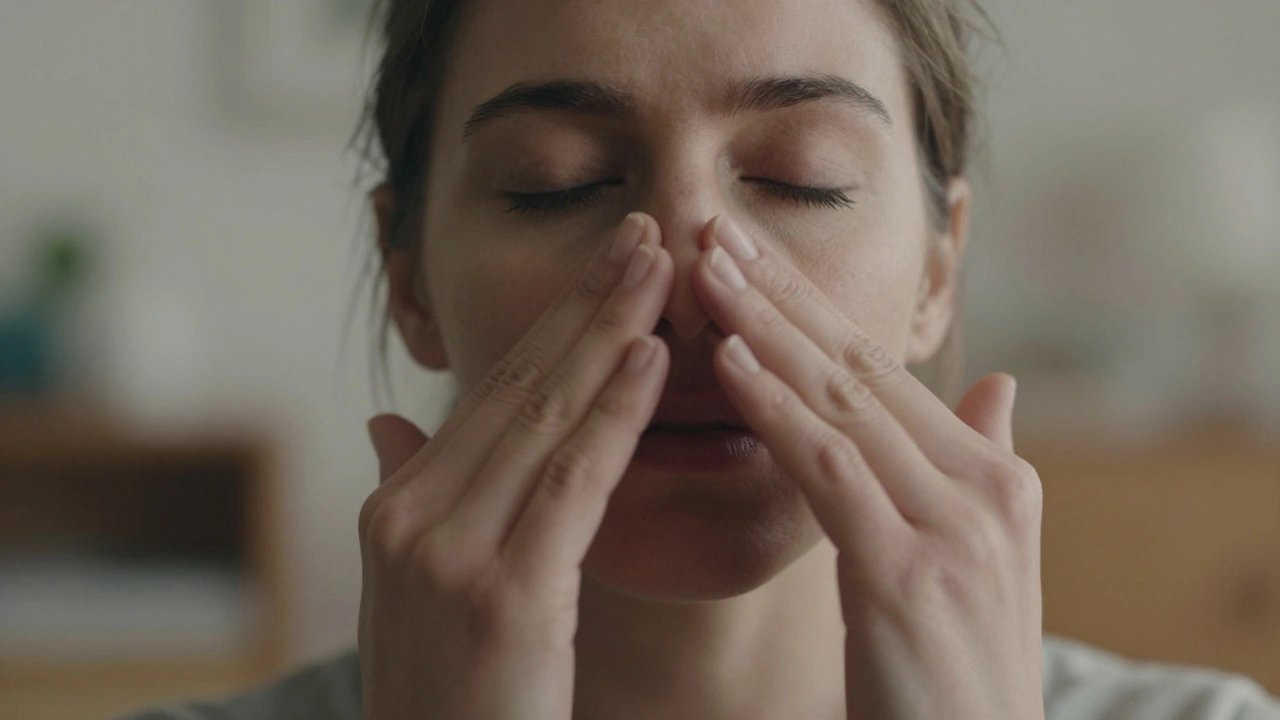
2. Alternate Nostril Breathing (Nadi Shodhana)
This technique balances the left and right sides of your brain-logical and emotional. It’s been used for centuries to quiet mental chatter.
- Use your right thumb to close your right nostril.
- Inhale slowly through your left nostril for four counts.
- Close your left nostril with your ring finger. Hold for two counts.
- Open your right nostril and exhale for six counts.
- Inhale through the right, hold, then exhale through the left.
- That’s one cycle. Do 5-7 cycles.
It sounds complicated, but your hands will remember after two tries. It’s like a mental reset button with your fingers.
3. The Tantric Wave Breath
This one’s for when you’re feeling overwhelmed-like your thoughts are a storm.
- Inhale through your nose for four counts, filling your belly, then your ribs, then your upper chest.
- Exhale slowly through your mouth, emptying from the top down-chest, ribs, belly.
- Imagine breathing in calm like a warm wave, and breathing out tension like foam dissolving into the sea.
- Do this for 3-5 minutes.
It’s called the wave because it moves through your body. You’re not just breathing-you’re washing out the stress.
When and Where to Practice
You don’t need a yoga mat or a silent room. Tantric breathing works best when it’s woven into your day-not added on top of it.
- Morning: Before checking your phone, sit up in bed and do five rounds of belly breathing. Start your day grounded.
- Before meetings: Take three slow breaths before walking into a tense conversation. You’ll speak calmer, think clearer.
- At your desk: Set a reminder for 2 p.m. Every day. Two minutes of alternate nostril breathing. You’ll surprise yourself with how much more focused you feel.
- At night: Lie on your back, hands on your belly. Breathe slowly until your body feels heavy. Fall asleep naturally.
Consistency beats duration. Five minutes a day, every day, changes more than an hour once a week.
What to Avoid
Even simple things can go wrong if done without awareness.
- Don’t force it. If you feel dizzy, slow down. Breathing should feel like a gentle tide, not a workout.
- Don’t hold your breath too long. Two-second holds are enough. Longer can trigger anxiety, not calm.
- Don’t compare. Your breath isn’t supposed to sound like someone else’s. Some people breathe loud. Some are silent. Both are fine.
- Don’t wait for “the right time.” There is no perfect moment. The best time is now.

Tantric Breathing vs. Regular Deep Breathing
| Aspect | Tantric Breathing | Regular Deep Breathing |
|---|---|---|
| Focus | Energy flow, mindfulness, body awareness | Simply increasing oxygen intake |
| Technique | Structured patterns (alternate nostril, wave breath) | General inhale-exhale with longer duration |
| Goal | Emotional regulation, spiritual connection, nervous system reset | Relaxation, reducing acute stress |
| Duration | 5-15 minutes daily recommended | Can be done in 1-2 minutes |
| Effect on Mind | Reduces mental chatter, enhances presence | Reduces physical tension |
Tantric breathing doesn’t just relax your body-it quiets your mind. Regular deep breathing helps. But tantric breathing transforms how you relate to your thoughts.
Frequently Asked Questions
Can anyone do tantric breathing, even if I’m not spiritual?
Absolutely. You don’t need to believe in chakras, energy fields, or ancient gods to benefit. Tantric breathing is a physical technique that works on your nervous system. Think of it like stretching-you don’t need to believe in yoga to feel better after a good stretch.
How long until I feel the effects?
Some people feel calmer after one session. Others notice changes after a few days. The key is consistency. After a week of daily practice, most people report feeling less reactive, sleeping better, and having more mental space between thoughts and reactions.
Can I combine tantric breathing with meditation?
Yes, and it’s powerful. Tantric breathing is actually a form of moving meditation. After a few rounds of belly breathing, your mind naturally settles. That’s when you can sit quietly and just observe your thoughts without chasing them. Many people find they meditate more easily after breathing first.
Is tantric breathing the same as box breathing or 4-7-8 breathing?
They’re cousins, not twins. Box breathing (4-4-4-4) and 4-7-8 are great for quick calm. Tantric breathing is more about rhythm, awareness, and energy flow. It’s less about timing and more about sensation. You can use them together-try 4-7-8 before bed, then tantric wave breath in the morning.
What if I can’t sit still? My mind races.
That’s normal. The goal isn’t to stop your thoughts-it’s to notice them without getting pulled in. Imagine your breath is a rope, and your thoughts are clouds passing by. You’re not fighting the clouds. You’re just holding onto the rope. Over time, the clouds stop feeling so loud.
Ready to Begin?
You don’t need to join a retreat. You don’t need to buy a book or an app. You just need to sit down-anywhere-and take one slow breath. Inhale through your nose. Let your belly rise. Exhale through your mouth. Let go.
Do that five times. Right now.
That’s it. That’s the whole practice.
Tomorrow, do it again. And the next day. And the day after that. In a few weeks, you won’t just be breathing differently. You’ll be living differently.

Marie Liao
December 27, 2025 AT 04:34The ontological underpinnings of tantric breathing are profoundly misaligned with contemporary neurophysiological paradigms. While the article invokes the parasympathetic nervous system, it fails to acknowledge that diaphragmatic respiration alone does not constitute a modality of energy transduction-this is a reification of Vedic metaphysics as biomedical mechanism. The term 'energy' here is a semantic contaminant, devoid of operational definition. One must question the epistemic legitimacy of conflating vagal tone with esoteric prana.
Furthermore, the cited Amsterdam study lacks methodological rigor: no control for placebo effect, no blinding, and no longitudinal fMRI validation. To assert a 37% reduction in perceived stress without objective biomarkers is pseudoscientific rhetoric dressed in yogic garb.
Steve Trojan
December 27, 2025 AT 19:28I’ve been teaching this to my clients for over a decade, and honestly? It works-not because of any mystical energy, but because it’s one of the few things that actually interrupts the stress loop. Your body doesn’t care if you call it ‘prana’ or ‘vagal tone’-it just responds to slow exhales. I’ve had trauma survivors, ICU nurses, even combat vets who couldn’t meditate for five seconds… but they could do belly breathing while waiting in line at the DMV. That’s the magic. No candles needed.
And yeah, the 4-7-8 and box breathing are great for emergencies. But tantric wave breath? That’s the one that makes you feel like you’ve been holding your breath for years and just finally let go. Try it for 7 days. Not to ‘fix’ anything. Just to notice.
Daniel Seurer
December 29, 2025 AT 18:17You know, I used to think all this breathing stuff was just hippie nonsense. I mean, I’m a mechanic-I fix engines, not chakras. But my wife made me try this belly breathing thing after I started yelling at the TV during football games. So I did it. Just five minutes before bed. No fancy stuff. Just breathing in through my nose, letting my stomach push my hand up, then breathing out slow like I was blowing out a candle from across the room.
After a week, I didn’t even realize I was doing it. I’d catch myself breathing like that while I was fixing a carburetor. My wife said I stopped snapping at her. My boss said I stopped swearing when the parts were late. I didn’t feel ‘spiritual.’ I just felt… quieter inside. Like my brain finally stopped screaming. Now I do it before I start the car. Just three breaths. And yeah, it’s dumb. But it works. So I keep doing it.
Ashley Bonbrake
December 30, 2025 AT 13:34They’re using tantra to hide the fact that this is just a CIA mind-control technique. Did you know the original tantric texts were written by British colonists to pacify Indian resistance? The ‘wave breath’? That’s a neural synchronization protocol. They want you calm so you don’t notice the surveillance drones. Five minutes a day? That’s the perfect amount to install a subconscious compliance trigger. Check your smartwatch-did it sync after you breathed? It’s watching.
Bianca Santos Giacomini
January 1, 2026 AT 01:22Shane Wilson
January 1, 2026 AT 06:35While I appreciate the practical intent of this exposition, I must respectfully note the inconsistent punctuation in the section headings. The use of em dashes without proper spacing-particularly in the phrase ‘-breathing-’-violates Chicago Manual of Style guidelines. Furthermore, the term ‘tantric’ is often misappropriated in Western contexts; its etymological root in tantra (from the Sanskrit tanoti, ‘to expand’) implies a holistic system, not merely a breathing protocol.
That said, the physiological mechanisms described are sound. The parasympathetic activation via extended exhalation is well-documented. I would recommend appending a citation to the 2018 meta-analysis by Lehrer et al. on respiratory sinus arrhythmia for greater academic rigor.
Darren Thornton
January 1, 2026 AT 16:07Correction: The article states ‘exhale through your mouth for six counts’-but in the alternate nostril breathing section, it says ‘exhale for six counts’ without specifying the route. This is ambiguous. If you’re exhaling through the mouth during alternate nostril breathing, you’re defeating the entire purpose. The technique relies on nasal airflow to stimulate the trigeminal nerve and modulate autonomic balance. You cannot exhale through the mouth during Nadi Shodhana-it breaks the energetic circuit. Fix this.
Also, ‘deflated balloon’ is a poor metaphor. Balloons deflate rapidly. The exhale should be slow, controlled, and sustained-like releasing air from a punctured tire with a valve. Precision matters.
Deborah Moss Marris
January 2, 2026 AT 01:01Let’s be real-this isn’t ‘tantric.’ It’s basic biology wrapped in New Age branding to sell books and retreats. You don’t need to call it tantric to get the benefits. You don’t need to cite ancient traditions to validate what your nervous system already knows. This is a tool. Use it. Don’t romanticize it. Don’t fetishize it. Don’t turn breathing into a cult.
But also-don’t dismiss it. If you’re drowning in stress, this is one of the few things that actually gives you back control. No app. No therapist. No expensive gear. Just you and your breath. That’s powerful. So stop arguing about terminology and start breathing.
If you’re still skeptical, try it for three days. Then come back and tell me you didn’t feel something shift. I dare you.
Kimberly Bolletino
January 2, 2026 AT 07:21I tried this. I really did. For two weeks. Every morning. Five minutes. Belly breathing. Wave breath. Everything. I felt nothing. Just more tired. And then I realized-I was doing it while scrolling Instagram. I was breathing deep… but my mind was still screaming about my ex’s new relationship status and my boss’s passive-aggressive Slack message.
So I stopped. I didn’t need to breathe differently. I needed to stop living like my brain was on fire. Maybe the problem isn’t my breath. Maybe it’s my life. And maybe breathing isn’t the fix-it’s the distraction.
Now I just yell into a pillow. It’s cheaper. And I feel better.
Elina Willett
January 3, 2026 AT 21:03Okay but what if breathing is just capitalism’s way of making us accept our suffering? Like, instead of fixing the 80-hour workweeks, the housing crisis, the endless toxicity of modern life-they give us breathing apps so we think we’re healing ourselves while the system keeps crushing us?
And why is it always ‘tantric’? Why not ‘medieval monk breathing’ or ‘Viking calm breath’? Because tantra sounds exotic and spiritual and makes people pay $299 for a PDF. This is spiritual capitalism 101.
Also, I tried the wave breath and it made me dizzy. So I stopped. And then I laughed. Because I realized-I was trying to ‘fix’ my anxiety by breathing harder. Maybe the real tantric practice is just… not trying to fix anything at all.
So I stopped. I breathed normally. And I didn’t care. And that was the most peaceful moment I’ve had in months.