Deep Tissue Massage: A Powerful Ally in Managing Arthritis
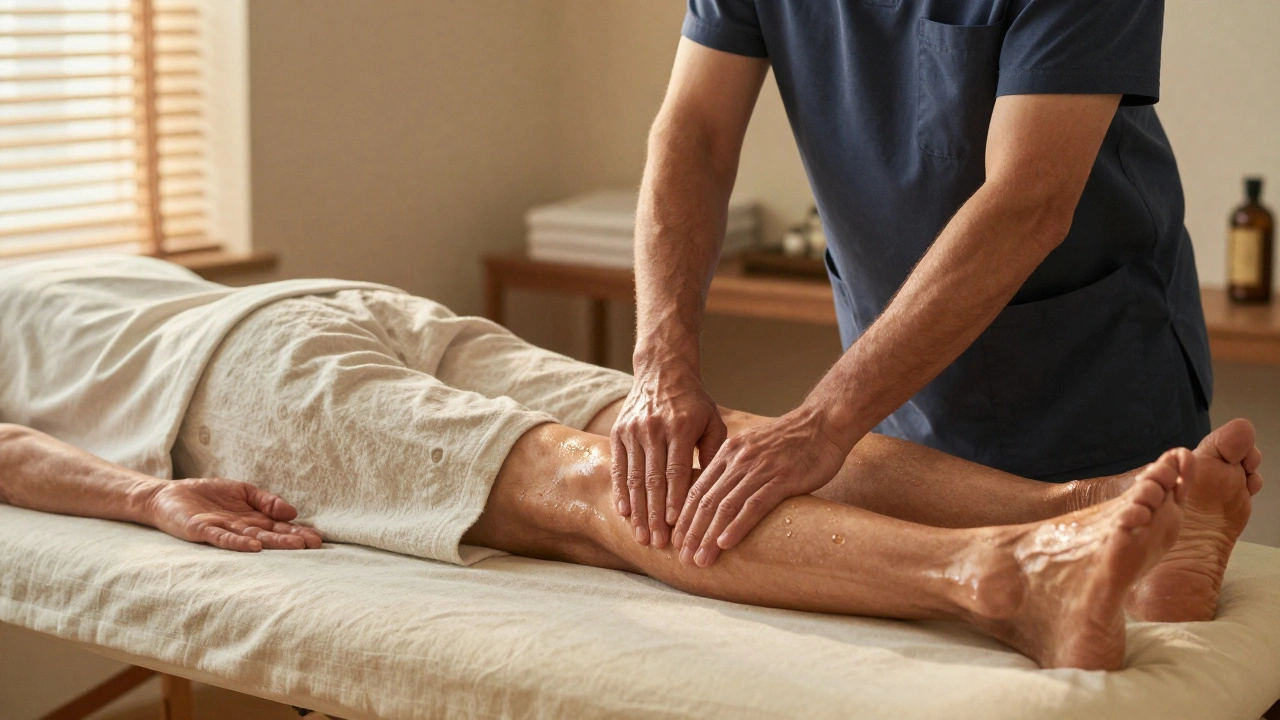
You’ve got stiffness in your knees that won’t quit. Your fingers ache every morning. You’ve tried painkillers, physical therapy, even heat packs-but nothing gives you real, lasting relief. What if the answer isn’t another pill, but your hands-someone else’s hands-working deep into the muscle around your joints?
Deep tissue massage isn’t just for athletes or people with sore backs. For millions living with arthritis, it’s becoming a quiet game-changer. Not because it cures the disease, but because it quietly takes the edge off the pain, loosens the tightness that makes movement feel like walking through mud, and helps you get back some of the simple joys you thought were gone for good.
What Is Deep Tissue Massage, Really?
Deep tissue massage isn’t about being painful. It’s about being purposeful. While Swedish massage glides over the surface like a feather, deep tissue works slower, deeper, and with more pressure-targeting the layers of muscle and connective tissue beneath. Think of it like untangling a knot that’s been there for years. The therapist uses fingers, thumbs, elbows, even forearms to apply focused pressure along muscle fibers, tendons, and fascia.
It’s not magic. It’s science. Studies from the Journal of Clinical Rheumatology show that people with osteoarthritis who received regular deep tissue massage reported up to a 35% reduction in pain after eight weeks. Why? Because the pressure helps break up adhesions-those sticky, stiff patches that form between muscles and tendons when joints are inflamed and underused. It also increases blood flow to the area, bringing oxygen and nutrients that help repair tissue and flush out inflammatory chemicals.
Why Deep Tissue Works for Arthritis
Arthritis doesn’t just hurt your joints. It makes the muscles around them tighten up-like a protective shield that never turns off. That tightness pulls on your bones, increases pressure on the joint, and makes every step feel heavier. Deep tissue massage interrupts that cycle.
Here’s how it helps, step by step:
- Reduces muscle tension: Tight quads, hamstrings, and calves make knee arthritis worse. Massage loosens them, taking pressure off the joint.
- Improves circulation: Better blood flow means less swelling and faster removal of pain-causing chemicals like cytokines.
- Decreases stiffness: Regular sessions can increase your range of motion by 15-20% over time, making it easier to bend, reach, or stand up.
- Lowers stress hormones: Chronic pain raises cortisol. Massage lowers it. Less stress = less perceived pain.
- Boosts endorphins: Your body’s natural painkillers get a boost-no prescription needed.
One woman in Utrecht, 68, with rheumatoid arthritis in her hands, told me she hadn’t been able to open a jar for six months. After six weekly sessions focused on her forearms and wrists, she made herself tea again. "It didn’t fix my joints," she said. "But it fixed my ability to live with them."
What to Expect During a Session
First thing: you won’t be naked on a table. You’ll be covered with a sheet, and only the area being worked on will be exposed. You’ll lie on your back, side, or stomach-whatever’s most comfortable for your joints.
The therapist will start with lighter strokes to warm up the tissue. Then, they’ll slowly increase pressure. It should feel like a "good hurt"-not sharp, burning, or unbearable. If it hurts too much, speak up. Good therapists adjust on the spot.
They might use oil or lotion to reduce friction. You’ll feel slow, deliberate movements-long strokes along your thigh, circular pressure around your hip, sustained pressure along your spine. Sessions usually last 60 to 75 minutes. The first one might feel intense, but after a few, your body learns to relax into it.
Afterward, you might feel slightly sore for a day or two-like after a good workout. Drink water. Move gently. You’ll feel looser and lighter within 48 hours.
Deep Tissue vs. Swedish Massage for Arthritis
| Feature | Deep Tissue Massage | Swedish Massage |
|---|---|---|
| Pressure Level | High, focused | Light to moderate, flowing |
| Primary Goal | Release deep muscle tension, break adhesions | Relax surface muscles, improve circulation |
| Best For Arthritis? | Yes-targets stiff muscles around joints | Only for mild cases or flare-up recovery |
| Duration of Relief | 3-7 days per session | 1-3 days |
| Post-Session Soreness | Mild to moderate | Minimal |
| Frequency Recommended | Once every 1-2 weeks | Once a week or as needed |
Swedish massage feels wonderful, especially during a flare-up. But if your pain is rooted in years of muscle guarding and stiffness, deep tissue gets to the root. Think of Swedish as a vacation. Deep tissue is rehab.

Where to Find Quality Deep Tissue Massage in Amsterdam
Not every massage therapist knows how to work with arthritis. Look for practitioners who specialize in therapeutic or clinical massage, not just relaxation. In Amsterdam, clinics like Bodywise Therapeutics in De Pijp and Physio & Massage Collective near the Amstel River have therapists trained in working with chronic pain conditions.
Ask these questions before booking:
- "Do you have experience working with clients who have arthritis?"
- "Will you adjust pressure based on my pain levels?"
- "Can you work around inflamed joints without aggravating them?"
Some physiotherapy clinics also offer deep tissue as part of a pain management plan. Check with your doctor-they might even refer you.
Safety First: Who Should Avoid It
Deep tissue massage is safe for most people with arthritis-but not all. Avoid it if you have:
- Active joint inflammation (hot, swollen, red joints)
- Bone fractures or recent surgery near the area
- Blood clotting disorders or are on blood thinners
- Severe osteoporosis (bones too fragile for deep pressure)
If you’re unsure, talk to your rheumatologist first. A good therapist will ask for your medical history and may even ask for a note from your doctor-especially if you’re on immunosuppressants or have autoimmune arthritis.
Also, avoid deep tissue during a flare-up. Wait until the swelling goes down. That’s when gentle movement and light massage help more than deep pressure.
How Often Should You Get It?
There’s no one-size-fits-all. But here’s what most people with arthritis find works:
- Weeks 1-4: Once a week to reset tight patterns
- Weeks 5-12: Every two weeks to maintain gains
- After 3 months: Once a month for maintenance
Some people notice improvement after just one session. Others need three to four. It’s not about speed-it’s about consistency. Think of it like brushing your teeth. One time won’t fix cavities. Daily care prevents them.

Can You Do It at Home?
Yes-and you should. Massage doesn’t have to be expensive to be effective. Use a foam roller on your thighs or calves. Roll a tennis ball under your foot if you have foot arthritis. Use your knuckles to apply slow, firm circles around your knees or elbows.
Try this simple routine after a warm shower:
- Apply a warming oil or cream to your hands and joints.
- Use your thumbs to press and hold for 5 seconds on tight spots around your knees or wrists.
- Roll gently along the muscle, not over the joint.
- Repeat 3-5 times per area.
- Do this for 10 minutes a day.
It’s not a replacement for professional care-but it’s a powerful daily tool.
Frequently Asked Questions
Can deep tissue massage make arthritis worse?
Only if done too aggressively or during a flare-up. When performed correctly by a trained therapist who understands arthritis, it reduces pain and stiffness. If you feel sharp pain, burning, or increased swelling after a session, stop and consult your doctor. Mild soreness is normal. Increased joint pain is not.
Is deep tissue massage covered by insurance in the Netherlands?
It depends on your supplementary insurance. Many Dutch insurers like Menzis, CZ, or Aevitae cover massage therapy if it’s prescribed by a physiotherapist or doctor as part of a chronic pain management plan. Always ask your insurer first-some require a referral. Don’t assume it’s covered, but don’t assume it’s not either.
How long does it take to feel results?
Most people feel more relaxed after the first session. Real changes in pain and mobility usually show up after 3-4 sessions. For lasting results, consistency matters more than intensity. Think of it as building muscle memory for comfort.
Can I combine deep tissue massage with other arthritis treatments?
Absolutely. Many people combine it with physical therapy, swimming, yoga, or even acupuncture. It complements them well. Just avoid scheduling deep tissue on the same day as intense physical therapy. Give your body time to recover between sessions.
What if I can’t afford regular sessions?
Start with self-massage using a foam roller or tennis ball for 10 minutes a day. Look for community wellness centers or massage schools in Amsterdam that offer discounted sessions by students under supervision. Some NGOs and senior centers also provide low-cost therapeutic massage programs. Small, regular efforts add up.
Final Thought: It’s Not About Fixing Your Joints
Deep tissue massage won’t reverse arthritis. But it can help you stop fighting your body every day. It doesn’t erase pain-but it gives you back control. You stop dreading the morning. You start opening jars again. You walk to the park without needing a cane.
Arthritis takes a lot from you. But it doesn’t have to take your comfort, your movement, or your peace. Sometimes, the most powerful medicine isn’t in a bottle. It’s in the hands of someone who knows how to listen-to your pain, to your body, and to the quiet spaces between.
Ready to feel lighter? Book your first session. Your joints will thank you.


Kari Watkins
January 24, 2026 AT 07:47OMG I CRIED AFTER MY FIRST SESSION 😭 I hadn’t opened a jar in 2 years and now I’m making peanut butter sandwiches like a boss 🥪💪 Deep tissue didn’t just help my knees-it gave me my life back. I’m not ‘just aging,’ I’m THRIVING. #MassageIsMedicine
Emily Cross
January 26, 2026 AT 05:05Interesting. But let’s be real-this is just glorified pressure point manipulation with a $120 price tag. Studies? Sure. But correlation isn’t causation. And who’s to say it’s not just placebo? Also, ‘good hurt’? That’s not a medical term. I’m not saying it doesn’t help-I’m saying we need more double-blind trials. And why is everyone so obsessed with ‘fixing’ pain instead of accepting it as part of aging?
Amit krishna Dhawan
January 26, 2026 AT 23:35Brother, you don’t know what you’re talking about! In India, we’ve been doing this for centuries-Ayurvedic abhyanga is the OG deep tissue! This isn’t some new-age fad, it’s ancient wisdom wrapped in a spa towel. You think science invented pressure? Nah. Grandmas in Kerala invented it while massaging their grandkids’ legs after school. Respect the roots, bro.
Abhishek Gowda
January 27, 2026 AT 19:40I just cried reading this. 😭 My mom has RA and she’s been stuck in bed for months. I booked her a session last week and she texted me at 3am saying ‘I felt my toes again.’ I don’t care if it’s science or magic-I’m booking 12 more. This is the first time she’s smiled since 2022. Thank you for writing this.
Ashok kumar
January 28, 2026 AT 02:16Let me be perfectly clear: This is not a ‘treatment’-it’s a revolution in how we perceive pain! You’re not ‘managing’ arthritis-you’re reclaiming your autonomy from a medical-industrial complex that wants you dependent on pills! Who benefits from your suffering? The pharmaceutical giants! And now, with one massage, you’re saying NO-NO to numbness, NO to passivity, NO to being told you’re ‘just getting old’! This is liberation-through pressure! And if you don’t get it, you’re part of the problem!
Amal Benkirane
January 28, 2026 AT 18:27I’ve been doing this for my dad for 8 months now. He’s 74, has knee OA. We do the tennis ball roll every night after dinner. He doesn’t say much, but he sleeps better. That’s enough for me. No need for grand claims. Just gentle hands, quiet moments. That’s what matters.
Kelly O'Leary
January 29, 2026 AT 05:43As someone from Ireland who’s seen my aunt recover from hip surgery with massage therapy-I’m so glad this is getting attention. I’ve recommended this to three friends already. The key is finding someone who listens. Not just presses. A good therapist will pause. They’ll check in. They’ll let you guide them. That’s the real healing.
Kathryn MERCHENT
January 29, 2026 AT 21:51Why are we paying for this when we have the best medical system in the world? In America we have doctors who know what’s real. This is just another hippie trend. You want relief? Take your meds. Do your PT. Stop wasting money on people rubbing your legs like you’re some kind of yoga retreat. We don’t need this. We have science.
Ayush Pandey
January 30, 2026 AT 00:34There’s a deeper truth here. Pain is not merely physical-it’s a conversation your body is having with your soul. Deep tissue doesn’t just release muscle-it releases the fear you’ve stored there for years. The fear of being a burden. The fear of losing independence. The fear that you’re no longer whole. The hands of the therapist? They’re not just touching skin. They’re touching your dignity. And that’s why it works. Not because of blood flow. But because you finally feel seen.